Workbench and charging corner
Trades, workshops, maintenance
Power tool batteries charge on the bench or on shelves next to combustible material. Charging is the critical state because energy is being fed in.
batrea · lithium-ion battery storage cabinet
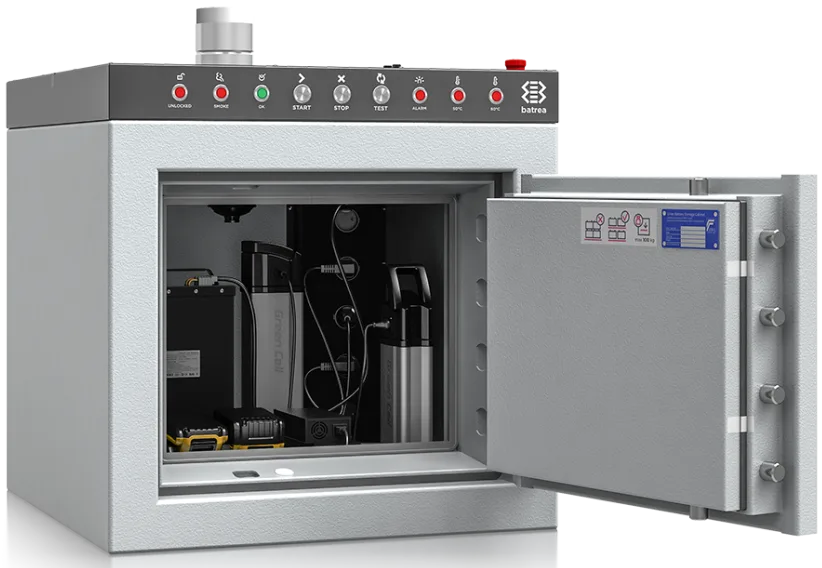
batrea is a fire-resistant storage cabinet for storing and charging lithium-ion batteries. Tested and certified to VDMA standard sheet 24994:2024-08 in classes I/O30 and I/O60. Offered through the specialist trade, with contacts at Müller Safe in Herborn, Germany.

A lithium-ion battery storage cabinet is a closed, fire-resistant enclosure in which batteries are stored and charged so that a thermal runaway stays contained, is detected early and its gases are extracted in a controlled way. The benchmark for such cabinets is VDMA standard sheet 24994:2024-08. batrea is certified to it in classes I/O30 and I/O60, allows charging inside the cabinet and holds up to 3000 Wh per storage level. Also called battery charging cabinet or fire-resistant battery cabinet.
Last updated:
On record
Certificates 2201/LIB25-02 (I/O60, size 1) and 2201/LIB25-03 (I/O30, sizes 1 to 3), issued by European Certification Body GmbH (ECB•S), valid until 7 April 2029.
A thermal runaway is a self-accelerating reaction inside a lithium-ion cell: above a critical temperature the separator, electrolyte and electrode materials decompose, the cell keeps heating itself, releases flammable and toxic gases and can drag neighbouring cells into the same reaction.
What sets it apart from an ordinary fire is that the energy sits inside the cell. Cutting off oxygen therefore helps only to a limited degree, and a cell that appears extinguished can reignite. The German accident insurers describe triggers, course and firefighting strategy in DGUV Information 205-041 (March 2024); the five states below summarise it.
Overheating, overcharging or an internal short circuit. Prior damage from impact, dropping, heat, frost or direct sunlight raises the risk.
Source: DGUV Information 205-041, 2024
The cell heats faster than it can shed heat. Nothing is visible from outside at first; a temperature rise in the storage area is the first measurable signal.
Source: DGUV Information 205-041, 2024
When the pressure relief opens, a white-grey, flammable mist of electrolyte and cell components escapes. The gases and dusts released are partly highly toxic or carcinogenic.
Source: DGUV Information 205-041, 2024
The gas mixture ignites. A battery fire rarely occurs without explosive combustion and without the release of ignitable gases.
Source: GIT Sicherheit, interview on VDMA standard sheet 24994, 2025
The reaction jumps to neighbouring cells and batteries (thermal propagation). Every protective measure therefore aims to confine the event to the affected battery and to cool it for a long time.
Source: DGUV Information 205-041, section 6.3, 2024
The fire itself is not the whole risk; its consequences are: smoke in the building, spread to stored goods, business interruption and the question whether the property insurer accepts the storage arrangement as proper. A tested storage cabinet answers exactly these questions. It does not answer the question of battery quality.
All statements in this chapter are guidance drawn from public sources. The current versions of the respective regulations apply.
Lithium-ion batteries are rarely the core business of a company. They accumulate: in tool cases, on chargers, in return crates, in vehicles. The situations below are typical starting points of an enquiry. For resellers they double as a map of the target groups.
Scroll sideways or use the arrows
Trades, workshops, maintenance
Power tool batteries charge on the bench or on shelves next to combustible material. Charging is the critical state because energy is being fed in.
E-bikes, pedelecs, cargo bikes
Customer batteries with several hundred watt-hours are charged, stored and accepted for repair, often in the sales area.
Retail, service, repair
Returned or damaged batteries of unknown condition wait for inspection or disposal. Swollen or damaged batteries must not be charged.
Facility services, intralogistics
Swappable batteries for scrubber-dryers, pallet trucks and order pickers are recharged continuously in shift operation.
Education, research
Measuring instruments, prototypes and collections of small batteries in rooms with many people and changing use.
Warehouse, shipping, dangerous goods
Batteries are collected, packed and prepared for transport; storage and charging belong in separate places.
Depots, fire brigades, ambulance services
Battery-powered equipment on permanent standby, frequently in vehicle halls alongside other kit.
Practices, hospitals, test labs
Device batteries that must be available at all times and therefore stay on the charger permanently.
A lithium-ion battery storage cabinet is a closed enclosure that separates batteries from their surroundings during storage and charging, contains an event inside, detects temperature and smoke and extracts gases in a controlled way. What such a cabinet has to withstand is defined by VDMA standard sheet 24994:2024-08.
The batteries sit in a multi-walled, locked enclosure, not on the workbench.
Body, door, bolt work and seal keep flames, pressure and smoke inside.
Sensors report a temperature rise and smoke before anyone outside notices.
An exhaust air connection removes gases; in an emergency the flap closes automatically.
An ordinary steel cabinet, or a hazardous materials cabinet to EN 14470-1, is designed for fire from outside: it protects the contents from a room fire for a defined time. A thermal runaway takes place inside, with pressure, gas and heat. The European Security Systems Association (ESSA) points out that EN 14470-1 is not comparable with VDMA 24994 because it does not test the explosion risk inside the cabinet (Protector, May 2025).
VDMA 24994:2024-08 is a standard sheet of the German Mechanical Engineering Industry Association (VDMA) setting out test requirements for fire-resistant storage cabinets for lithium-ion batteries in the event of a thermal runaway. Published in August 2024, it applies to removable, portable batteries of up to 25 kg that may also be charged inside the cabinet.
Sources: FeuerTRUTZ (July 2024), GIT Sicherheit (2025), Protector/ESSA (May 2025). Reproduced as guidance; the standard sheet itself is available from the VDMA and DIN Media.
The certification scheme knows four classes: I, I/O30, I/O60 and I/O90. "I" stands for the internal fire test passed; the number after "O" is the duration of the additional external fire test in minutes. batrea is certified in classes I/O30 and I/O60. Which class suits a location depends on the fire load of the surroundings and on the requirements of insurer and risk assessment; we advise on this. The documents available to us do not describe a technical difference in the construction of the two batrea classes.
These German regulations address the operator, not the cabinet. They help resellers in advising customers; the current original text is binding. Requirements in other countries differ.
batrea comes from safe manufacturing: body and door are multi-walled, the door locks on four sides through bolt work, and an expansion and smoke seal closes the gap. The section drawing shows what the data sheet describes and nothing beyond it.
Multi-walled construction of the cabinet, body and door with a special combination of insulating materials. The inner wall holds the event; the insulation limits heat transfer to the outside.
A single multi-walled door leaf closes the front. Body and door construction are based on resistance grade I according to EN 1143-1.
The door locks on four sides, all round via bolt work. In an event it stays shut instead of being forced open by pressure.
A special expansion and smoke seal in the door rebate closes the gap between door and body against smoke.
The DN100 galvanised steel ventilation connection links the cabinet to the on-site exhaust system; minimum air flow 30 m³ per hour. In an emergency the ventilation flap closes automatically, and its position is indicated.
The control panel top in RAL 9005 sits on the body and carries the diagnostic control panel, the fuse box and the emergency stop button. The body is finished in RAL 7035; handle and key escutcheon are black.
Key lock class A with two 120 mm keys, or electronic lock class A. Two through-holes in the base for optional anchoring at the installation site.
A batrea weighs between 294 and 630 kg. That is a selling point and a planning task at the same time. Resellers do well to settle these points before quoting.
Müller Safe GmbH in Herborn, Germany, manufactures safes and security containers in its own plant (laser cutting, bending, welding, powder coating) and is a member of the VDMA security systems association and of the European Security Systems Association (ESSA). Müller Safe looks after batrea in the German market: advice, quotation, delivery, after-sales.
The control panel top carries LED indicators, piezoelectric buttons, the emergency stop and the fuse box. The assignment of the ten elements comes from the manufacturer's quick guide (V 1.0). Tap or click a marker.
The intuitive diagnostic control panel with piezoelectric buttons reports a temperature rise inside the cabinet: warning at raised temperature, critical alarm at critical temperature.
Smoke detection inside the cabinet. Smoke is among the first signs of a developing event and triggers the critical alarm.
Automatic ventilation shutdown when a high temperature (60 °C) is detected. The ventilation flap closes automatically in an emergency; its position is indicated.
With the door open the system neither starts nor continues charging. Doors must stay closed during storage and charging.
Emergency shutdown (STOP/EMERGENCY), buzzer for acoustic signals and a fuse set with two fuses in the fuse box above the control panel.
The manufacturer's quick guide is unambiguous: during a critical alarm do not open the cabinet door, because the cabinet is designed to contain a possible fire inside. Assess the situation from a safe distance; if you see smoke or fire, call the emergency number and state that a lithium-ion battery cabinet is involved, warn others and evacuate. If the alarm persists without visible signs, inform the person responsible and do not resume operation on your own.
Source: Quick guide batrea storage cabinet, V 1.0, section 6 (manufacturer document)
The size determines storage levels, sockets, capacity and weight. All values come from the data sheet and apply equally to both classes.


| 1 batrea 1 | 2 batrea 2 | 3 batrea 3 | |
|---|---|---|---|
| Article no. I/O60 | B470001.01.01 / .02 / .03 | B470002.01.01 / .02 / .03 | B470003.01.01 / .02 / .03 |
| Article no. I/O30 | B470006.01.01 / .02 / .03 | B470007.01.01 / .02 / .03 | B470008.01.01 / .02 / .03 |
| Sockets | 5 pcs | 15 pcs | 25 pcs |
| Storage levels / shelves | 1 / 0 | 3 / 2 | 5 / 4 |
| Max. energy per storage level | 3,000 Wh | 3,000 Wh | 3,000 Wh |
| Max. energy per cabinet | 3,000 Wh | 9,000 Wh | 15,000 Wh |
| Max. charging power per level | 3,000 W | 3,000 W | 3,000 W |
| Max. charging power per cabinet | 3,000 W | 3,680 W | 3,680 W |
| Load per shelf | 100 kg | 100 kg | 100 kg |
| Body height | 704 mm | 1,219 mm | 1,919 mm |
| Height of exhaust connection | min. 50 mm | min. 50 mm | min. 50 mm |
| Overall height | 754 mm | 1,269 mm | 1,969 mm |
| Body width | 711 mm | 711 mm | 711 mm |
| Width of ventilation spigot | – | 22 mm | 22 mm |
| Overall width | 711 mm | 733 mm | 733 mm |
| Body depth | 702 mm | 702 mm | 702 mm |
| Handle depth | 60 mm | 60 mm | 60 mm |
| Overall depth | 762 mm | 762 mm | 762 mm |
| Internal dimensions (H × W × D) | 452 × 566 × 471 mm | 966 × 544 × 471 mm | 1,666 × 544 × 471 mm |
| Door clearance (H × W) | 374 × 462 mm | 889 × 462 mm | 1,589 × 462 mm |
| Weight | 294 kg | 450 kg | 630 kg |
Suffix .01 = type E · .02 = type F · .03 = type G
Both classes are tested and certified to VDMA standard sheet 24994:2024-08. Chapter 3 explains what the classes mean. Certification scope per size according to the certificates available:
batrea 2 and 3 in class I/O60 are listed in the data sheet; their certification status is confirmed on request.
Four articles are currently listed on mueller-safe.de, all with socket type F. Availability of further variants and socket types on request.
The suffix of the article number denotes the socket type inside the cabinet. It follows the country of installation.
Under its terms and conditions Müller Safe delivers within Germany as a rule; deliveries to other countries by individual agreement. Please ask.
Product pages on mueller-safe.de: batrea category with all listed articles (currently populated on the German site only)
Three answers give a first recommendation. It does not replace advice and contains no price or availability statement.
Without JavaScript the recommendation appears on this page after submitting.
Under VDMA 24994 both classes denote a passed internal fire test ("I") and differ in the duration of the additional external fire test: 30 or 60 minutes of protection of the batteries against a fire from outside. Which class suits a location depends on surroundings, fire load and insurer requirements. The data sheets available do not document a difference in the construction of the two batrea classes; we clarify this in conversation.
Yes. According to the manufacturer's quick guide the cabinet must be connected to a suitable ventilation system. The connection is DN100 and the minimum air flow is 30 m³ per hour. In an emergency the ventilation flap closes automatically. The ventilation system itself is planned and installed on site.
That follows from the energy: a maximum of 3000 Wh and 3000 W charging power per storage level and 100 kg per shelf. batrea 1 has one level with 5 sockets (3000 Wh), batrea 2 three levels with 15 sockets (9000 Wh), batrea 3 five levels with 25 sockets (15000 Wh). The size finder on this page works it out for you.
Yes. batrea is a storage cabinet for storing and charging lithium-ion batteries. Charging runs through the sockets inside the cabinet and is switched with START and STOP on the control panel; with the door open, charging does not start.
No. The risk assessment remains the operator's duty. A certified storage cabinet is a technical protective measure that is documented in it and makes the protection level easier to assess.
In Germany, the insurers' guideline VdS 3103 places lithium batteries above 100 Wh in the medium power class and calls for fire-separated storage areas or clearances from combustible material. A cabinet certified to VDMA 24994 with a certificate on file is a solid basis for the conversation with the insurer; acceptance in the individual case rests with the insurer.
By freight forwarder with lifting equipment, after checking the transport route, door widths, lift and floor load capacity. Müller Safe collects these details with its transport and anchoring questionnaire; transport to upper floors and anchoring are agreed per site.
The control panel first reports a raised temperature (warning, 50 °C), then smoke or critical temperature (alarm, 60 °C) with a continuous tone; the ventilation flap closes automatically. The cabinet is designed to contain a possible fire inside. The door stays shut, people keep their distance and call the emergency number if they see smoke or fire.
Terms, price list, sample units and sales material are discussed directly with you. Use the dealer enquiry on this page or call us; the data sheets are available for download without a form so that you can pass them on to your customers.
Two routes for the trade, one for operators. Choose your topic; the fields adapt.
Data sheets are available without a form so that resellers can pass them on. Missing documents are marked "on request" and are not claimed.